Before you start
This page will help you:
- Understand what is happening.
- Know what is worth noticing.
- Know when you need a doctor.
It won’t ask you to:
- Diagnose yourself.
- Cut out dozens of foods.
- Stop your medicine.
- Read every symptom as dangerous.
The key idea
A trigger can bring an attack closer on a day when the brain is already primed for one, but it doesn’t cause migraine. Most of the things blamed for attacks have not held up when tested in controlled trials.
A trigger is not the cause
Migraine is a condition of the brain itself, and it often runs in families. A migraine brain is more sensitive to change: in sleep, meals, hormones and stress. A trigger is something that raises the chance of an attack on a particular day, not the thing that created the condition.
So treat any trigger you suspect as a hypothesis to test, not a verdict: does it come before attacks again and again? Do attacks happen on days without it? Was something else going on that same day? Rarely does one factor explain every attack.
That is also why avoiding triggers doesn’t cure migraine, and why an attack can come even after you’ve avoided everything you were told to. That doesn’t mean you did something wrong.
The threshold idea
Picture a glass that fills during the day: two hours less sleep, a late lunch, a tense day at work. None of them is enough alone to set off an attack, but together they may tip over the threshold. On another day the glass is nearly empty, and you eat the same thing with no effect.
This explains why triggers can seem “illogical”, and why it helps to look at the whole day rather than the last thing you ate.
Why is the evidence weaker than expected?
Most of what we know about triggers comes from asking people what they believe sets off their attacks. That is useful, but it isn’t proof. When researchers gave well-known triggers to people who didn’t know what they were taking, only a few produced more attacks than expected.
When the attack started before you felt it
Hours, sometimes a day, before the headache, the brain may go through an early phase: repeated yawning, tiredness, sensitivity to light, or a craving for something sweet. If you crave chocolate, eat it, and the headache follows, the chocolate looks guilty, when the craving itself was the first sign of the attack.
Food and drink
The clearest links here: skipped meals, alcohol, and caffeine that changes from day to day. The famous foods, like cheese, chocolate and sweeteners, have weak or conflicting evidence that doesn’t justify banning them for everyone.
Skipped meals and fasting among the strongest links
Hunger and late meals are among the most commonly reported triggers, and the link is clearer than for any single food. Low blood sugar and caffeine withdrawal can arrive together.
During Ramadan, many people find it helps not to skip suhoor and to cut down coffee gradually in the week or two before, rather than stopping suddenly. If you take preventive medicines or have frequent attacks, discuss medicine timing with your doctor before Ramadan.
Caffeine a two-way relationship
A small amount of caffeine can ease an attack, which is why it is part of some painkillers. But large daily amounts raise headache risk, and a sudden drop causes withdrawal headache, as on a weekend when you drink less, or when fasting.
What matters more than “how much” is “how steady”: a moderate, consistent daily amount is better than big swings. There’s no single number that suits everyone. If you drink a lot and want to cut down, do it slowly.
Alcohol one of the most consistent dietary triggers
Often reported, especially red wine; an attack may come within hours or the next day. Not everyone with migraine is affected.
Processed meats limited evidence
They contain nitrites, which have been linked to headache in a small number of people. No need to cut them out unless you see a repeated link yourself.
Aged cheese conflicting evidence
It contains tyramine and has been blamed for decades on the basis of old studies. Controlled studies haven’t consistently confirmed it.
MSG (monosodium glutamate) conflicting evidence
Controlled trials haven’t shown a consistent effect. Where an effect appeared, it was usually with large amounts taken without food, which isn’t how people normally eat.
Artificial sweeteners little and conflicting evidence
Some people name aspartame in particular. Studies are few and small, with inconsistent results. Avoiding them is only worthwhile if the link to your attacks is clear and repeated.
Chocolate and citrus not confirmed in trials
In a controlled trial, chocolate didn’t cause more headaches than a look-alike placebo. And, as above, craving it may be an early sign of a coming attack. The evidence for citrus is weaker still.
Water sensible, but direct effect uncertain
Some people notice thirst or dehydration before attacks, and drinking enough is a sensible habit for everyone. That drinking more reduces attacks hasn’t been clearly shown in the few small trials available.
Beyond food
Disturbed sleep, stress and the sudden let-down after it, and hormonal changes are among the most consistent triggers. And taking painkillers on many days a month can make the headache itself more frequent.
Sleep among the most consistent triggers
Too little sleep is linked to attacks, and so are too much and irregular sleep, like sleeping until noon at the weekend. What helps most: a steady wake-up time, even on days off.
Stress, and what comes after clearly linked
Stress is one of the most commonly reported triggers. Strikingly, the attack may come after the stress ends rather than during it: on the first day of a holiday, or after a deadline. A sudden drop in tension is a change, and the migraine brain is sensitive to change.
Hormonal changes clearly linked for many women
For many women attacks cluster around the period, from two days before to the first three days, linked to falling oestrogen. These attacks can be longer, and they have specific treatment options worth discussing with a doctor.
In pregnancy, migraine improves for many, especially after the first months. If you have migraine with aura, pills and patches that contain oestrogen are generally not advised, because together they raise the risk of stroke. Progestogen-only methods and non-hormonal options are usually fine; check with your doctor.
Light, smells and noise common, and overlap with the attack itself
Bright or flickering light and strong perfumes are widely reported. But sensitivity to light and smell is also part of the attack, so being bothered by them may be a sign the attack has begun, not its cause.
Weather and travel real for some people
Some people notice changes in air pressure and temperature; you can’t control these, so they’re not worth worrying over. Travel bundles several triggers together: broken sleep, late meals and tiredness.
Physical exertion sudden exertion only
Sudden hard exertion can set off attacks in some people. Regular moderate exercise, on the other hand, may help reduce them. A new headache that starts with exertion for the first time needs a medical check.
Painkiller overuse defined in the international classification
The painkiller that eases an attack can make headaches more frequent if taken on many days a month for months. The international classification sets an approximate threshold: 15 or more days a month for simple painkillers like paracetamol and ibuprofen, and 10 or more days for triptans and combination painkillers, for more than three months.
This isn’t addiction or weak willpower, and painkillers aren’t forbidden. It means it’s time for a plan with your doctor, often including preventive treatment. Don’t stop your medicines suddenly without advice.
Finding your pattern
Record your attacks for two or three months, then look for patterns with your doctor. Only avoid something if it is clearly and repeatedly linked to attacks, and test one thing at a time.
The headache diary
Memory plays tricks: we remember the bad attack and forget the quiet days. A simple diary gives you and your doctor a truer picture than any impression. On each headache day, note:
- The date, the time it started, and how long it lasted.
- How bad it was from 0 to 10, and where the pain was.
- What medicine you took, how many times, and whether it helped.
- Hours of sleep the night before, and whether you missed a meal.
- For women: the day of your cycle.
- Anything unusual about that day.
You don’t need to log everything you ate every day. Headache-free days need just a tick.
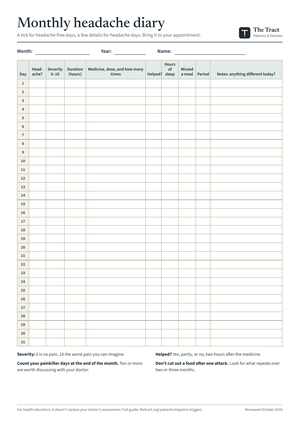
Monthly headache diary
One A4 page for a whole month, to print, pin up, or take to your appointment.
How to test one suspicion
If, after a few weeks, one thing seems to come before your attacks again and again, you can avoid it for a few weeks while you keep recording, then reintroduce it carefully and see. One thing at a time, not a whole list.
Cutting out many foods at once doesn’t help most people, and it can add new burdens: worry at every meal, a poorer diet, and guilt when the attack comes anyway.
Common questions
Coffee doesn’t have to go, fasting needs planning rather than fear, the popular “food intolerance” blood tests don’t help in migraine, and prevention is worth asking about if attacks are frequent.
When do I need preventive treatment?
New 2026Under the US guideline published in August 2026, prevention should be offered to anyone with four or more migraine days a month, four or more moderate-to-severe headache days a month, or migraine that disrupts work and daily life.
There are many options today: older tablets, newer medicines that target CGRP, including injections monthly or every three months and daily tablets, and Botox for chronic migraine. A tablet or injection is usually judged after 8 to 12 weeks at the right dose, and Botox after about six months. If one type doesn’t work, another may.
If you could become pregnant, ask your doctor about valproate and topiramate specifically; they should be avoided where possible because of the risk to a baby. What’s new in the guideline
Do I have to give up coffee completely?
Not necessarily. Consistency matters more: a moderate, steady amount each day. If you drink a lot, or notice headaches on days you miss your coffee, cutting down gradually is better than stopping suddenly.
Does fasting cause migraine? What about Ramadan?
Fasting doesn’t cause the condition, but it brings known triggers together: hunger, caffeine withdrawal and changed sleep. Planning before the month helps: cutting coffee gradually beforehand, not skipping suhoor, drinking water between iftar and suhoor, and reviewing medicine timing with your doctor.
Do I need a “food intolerance” test?
The widely sold tests that measure IgG antibodies to dozens of foods don’t diagnose real allergy, and headache guidelines don’t recommend them for finding migraine triggers. Their results often lead to cutting out foods for no reason.
Do screens and phones cause migraine?
There’s no strong evidence that the screen itself causes migraine. But late nights on it, eye strain and hours in a poor posture can all pile up in one day. And if light bothers you during an attack, that is part of the attack.
Is migraine inherited?
It often runs in families, because genes play a clear role. That doesn’t mean every child of a parent with migraine will have it.
Can migraine go away?
Migraine changes over a lifetime: it eases for many with age, and is affected by pregnancy and menopause. No treatment promises it will disappear for good, but a realistic goal, fewer and milder attacks with less impact on your life, is achievable for most people.
Questions you can ask your doctor
Pick the ones that fit, add your own, then copy or print them for your appointment.
When do you need urgent help?
Go to the emergency department or call an ambulance if the headache is as below. Saudi Arabia: 997 ambulance, or 911 unified emergency number. UK 999 · US 911 · most of Europe 112.
- Sudden and severe, peaking within about a minute, like the worst headache of your life.
- With weakness or numbness on one side, trouble speaking, vision problems that don’t clear, or confusion.
- With fever and a stiff neck, or a rash.
- After a blow to the head, especially if you take blood thinners.
- With an aura that lasts more than an hour, or is different from your usual aura.
- New or different during pregnancy or after giving birth.
- With a seizure or fainting, difficulty walking or keeping balance, or unusual drowsiness.
In these situations don’t assume it is your usual migraine, even if you have been diagnosed with migraine before.
See your doctor soon, without a long wait, if:
- A new headache starts after the age of 50.
- Your headache pattern changes clearly, or builds up over weeks.
- The headache wakes you from sleep, or gets worse with coughing or bending.
- You’re taking painkillers on 10 or more days a month.
- You have a condition that weakens immunity, or a history of cancer.
Medical sources
International Headache Society · Cephalalgia · 2018The International Classification of Headache Disorders, 3rd edition (ICHD-3). Cephalalgia 38(1):1–211. doi.org/10.1177/0333102417738202
Definitions of migraine and aura, and the thresholds for medication-overuse headache.
AAN · AHS · Neurology · 2026Pharmacologic treatment for migraine prevention in adults: practice guideline recommendations. Neurology 107(7):e214881. doi.org/10.1212/WNL.0000000000214881
When to offer prevention, the options, how long to try them, and pregnancy.
Kelman L · Cephalalgia · 2007The triggers or precipitants of the acute migraine attack. Cephalalgia 27(5):394–402. doi.org/10.1111/j.1468-2982.2007.01303.x
The triggers patients report most: stress, hormones, hunger and sleep.
Hindiyeh NA et al. · Headache · 2020The role of diet and nutrition in migraine triggers and treatment: a systematic literature review. Headache 60(7):1300–1316. doi.org/10.1111/head.13836
The evidence on caffeine, alcohol, fasting and suspected foods.
Giffin NJ et al. · Neurology · 2003Premonitory symptoms in migraine: an electronic diary study. Neurology 60(6):935–940. doi.org/10.1212/01.WNL.0000052998.58526.A9
The early phase: cravings, yawning and light sensitivity before the attack.
Marcus DA et al. · Cephalalgia · 1997A double-blind provocative study of chocolate as a trigger of headache. Cephalalgia 17(8):855–862. doi.org/10.1046/j.1468-2982.1997.1708855.x
Chocolate caused no more headaches than placebo in a controlled trial.
Do TP et al. · Neurology · 2019Red and orange flags for secondary headaches in clinical practice: SNNOOP10 list. Neurology 92(3):134–144.
Warning signs that need urgent assessment.
NICE · Clinical guideline CG150Headaches in over 12s: diagnosis and management. nice.org.uk/guidance/cg150
The headache diary, preventive treatment, and medication overuse.
What next?
- If you’re not sure whether a headache is dangerousWhen is a headache an emergency?
- If you see zigzag lines before the headacheAura in “Medical language”
- If attacks keep coming backThe headache diary
- If you take attack medicines oftenMedication-overuse headache
- If certain symptoms worry youWhen is a headache an emergency?
- If you have an appointment coming upWaiting for a doctor’s appointment
This page is for health education and does not replace assessment by a doctor who knows your story and has examined you. Don’t start or stop a medicine because of it. Found a mistake or something out of date? Write to us: contact@thetract.org