In thirty seconds
Stay with them, and check the time
When the seizure started is the most important thing you’ll need to know.
Make the space safe
Move hard and sharp things away, and put something soft under their head. Don’t hold their limbs.
On their side, once the jerking stops
Mouth pointing down, so saliva can drain and the airway stays open.
Call an ambulance now if:
Saudi Arabia: 997 ambulance, or 911 unified emergency number. UK 999 · US 911 · most of Europe 112.
- The seizure lasts five minutes or more.
- A second seizure starts before they wake from the first.
- They aren’t breathing normally after the jerking stops, or they aren’t starting to come round.
- It is their first ever seizure, or you don’t know whether they have epilepsy.
- It happened in water, or they were injured.
- They are pregnant, have diabetes, or are unwell with something else.
- The seizure is different from their usual ones, or you gave rescue medicine.
During the seizure: step by step
Stay calm and note the time, move danger away, protect the head, let the jerking happen, then turn them on their side and stay until they’re awake.
This is about the seizure where the person falls, stiffens and then jerks, the one people call a “fit” or “convulsion”.
Stay calm, and note when it started
Look at a clock or start a timer on your phone. If someone is with you, ask them to film the seizure; that video helps the doctor more than any description.
Move danger away, not the person
Move furniture, sharp objects and glass. Only move them if they’re in immediate danger: in the road, near fire, water or stairs.
Protect their head
Put something soft under it: a jacket, a cushion, or your hand. Remove glasses, and loosen anything tight around the neck, such as a collar, headscarf or tie.
Let the jerking happen
Holding their arms and legs down won’t stop the seizure, and it can break a bone or dislocate a shoulder.
When the jerking stops, turn them on their side
On their side, head tilted slightly back, mouth pointing down. They may seem to stop breathing for a few seconds while stiff; this is expected. Rescue breaths usually aren’t needed, and breathing returns by itself.
Stay until they’re back to themselves
Speak calmly, and tell them where they are and what happened. Look for a medical bracelet or card. Keep onlookers away; waking up in a crowd is embarrassing.
What not to do
Nothing in the mouth, no holding down, no onions, keys or water, and no food or medicine by mouth until they’re awake.
Some things people do with the best intentions cause real harm.
- put anything in their mouthNo spoon, stick, cloth, or your fingers. People cannot swallow their tongue; it isn’t anatomically possible. Things put in the mouth break teeth or snap and block the airway, and fingers can be bitten hard.
- wave onion or perfume under their noseIt doesn’t stop the seizure. The seizure ends by itself at the same moment, so the onion seems to have worked.
- put a key or metal in their handIt has nothing to do with the seizure, and can cut their hand while they jerk.
- splash water on them or put them in the showerWater doesn’t stop a seizure, and it can get into their lungs while they’re unconscious.
- give water, food or medicine by mouthNot until they’re fully awake and can swallow. Before that, anything in the mouth can go into the lungs.
- start CPR during the jerkingThe heart keeps beating during a seizure. CPR is only for someone who, after the seizure ends, isn’t breathing and doesn’t respond.
Not every seizure is a convulsion
Some seizures are quiet: staring, chewing, wandering. Stay close and guide them gently away from danger; don’t hold them firmly.
The person may stare into space, chew or fiddle with their clothes, or walk aimlessly, and not answer you. Then:
- Stay near and gently guide them away from danger: the road, stairs, the cooker.
- Don’t grip them hard or shout; they may resist without meaning to.
- Speak calmly until they’re back to themselves, and note how long it lasted.
Absence seizures in children, a few seconds of staring before carrying on as if nothing happened, don’t need an ambulance, but they do need a doctor if they haven’t been diagnosed.
After the seizure
Sleepiness, confusion and headache afterwards are expected. Let them rest on their side, and write down what you saw for the doctor.
After a seizure it is normal to be confused or very sleepy, to have a headache or aching muscles, to have bitten the tongue or wet oneself. All of this is expected, and it can last from minutes to hours.
Rescue medicine
Some people have a medicine prescribed for long seizures, such as midazolam given in the mouth or nose. Give it only if it has been prescribed for this person, following their doctor’s plan, usually at five minutes. If you give it, call an ambulance and tell them.
What the doctor needs to know
The person usually doesn’t remember the seizure, so your account is what counts:
- What they were doing just before, and whether they said they felt strange.
- How it began: on one side of the body? Did their eyes or head turn to one side?
- How long it lasted, and how long they took to come round.
- The video, if there is one. A minute of footage can change the diagnosis.
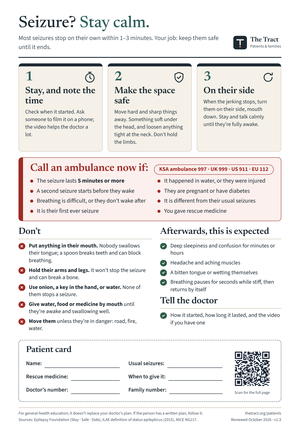
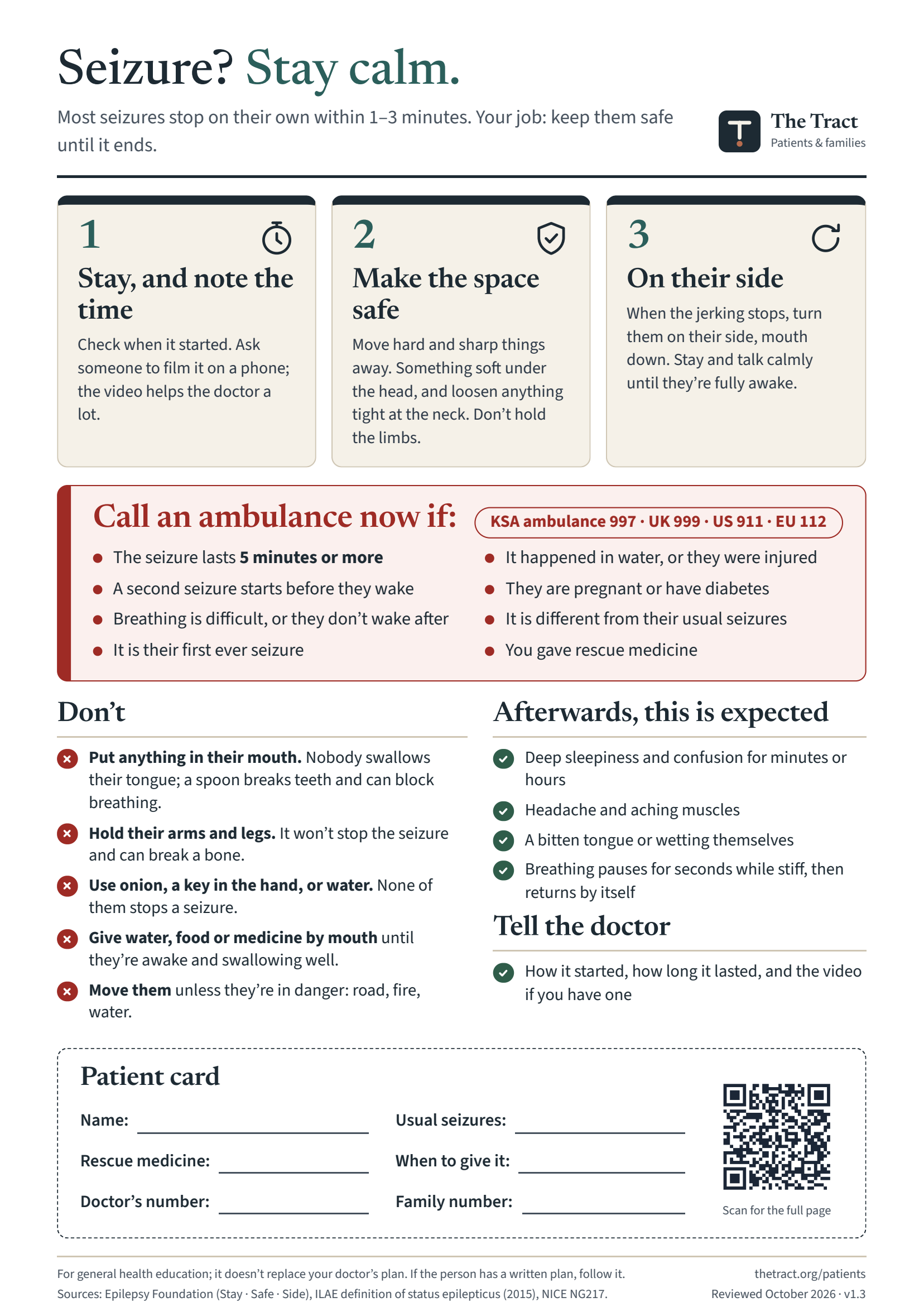
The fridge sheet
One A4 page with the steps, what not to do and when to call an ambulance, plus spaces for the person’s name, rescue medicine and doctor’s number.
Questions people ask
Most seizures stop on their own. Epilepsy isn’t contagious or possession. A first seizure always needs a doctor.
Can someone die from a seizure?
Most seizures stop on their own without harm. The real danger is in a seizure lasting more than five minutes or repeating without recovery, and in injuries: falls, drowning, burns. That is why we note the time and call an ambulance at five minutes.
Is epilepsy contagious? Is it possession?
Neither. Epilepsy is a disorder of the brain’s electrical activity. It is diagnosed from the story, examination, EEG and scans, and treated with medicines. Most people have their seizures controlled and live normal lives.
Does every seizure mean epilepsy?
No. A single seizure can come from a fever in a young child, low blood sugar or another cause. That is why a first seizure always needs a medical assessment.
My child had a fit with a fever. Is that epilepsy?
Febrile seizures are common between six months and five years, and most are simple and don’t mean epilepsy. But the first time it happens, the child needs to see a doctor, and first aid during the seizure is the same as on this page.
Questions you can ask the doctor
Pick the ones that fit, then copy or print them.
Medical sources
Epilepsy FoundationFirst aid for seizures: Stay, Safe, Side. epilepsy.com/recognition/first-aid-resources
First-aid steps, what not to do, and when to call for help.
Trinka E et al. · Epilepsia · 2015A definition and classification of status epilepticus: report of the ILAE Task Force. Epilepsia 56(10):1515–1523. doi.org/10.1111/epi.13121
Why five minutes is the line.
Fisher RS et al. · Epilepsia · 2014ILAE official report: a practical clinical definition of epilepsy. Epilepsia 55(4):475–482. doi.org/10.1111/epi.12550
When seizures count as epilepsy.
ILAE · Epilepsia · 2025Updated classification of epileptic seizures: position paper of the International League Against Epilepsy. doi.org/10.1111/epi.18338
Describing seizures by the order of what happens.
NICE · Guideline NG217 · 2022Epilepsies in children, young people and adults. nice.org.uk/guidance/ng217
Assessment after a first seizure, and rescue medicine.
What next?
- If you want fewer seizures day to dayWhat sets off epileptic seizures?
- If you’re unsure what the words meanSeizure, epilepsy and status epilepticus
- If an EEG has been requestedWaiting for an EEG
- If seizures keep happening and you have an appointmentWhat to bring and ask
- If you’re caring for the personFor families
This page is for health education and does not replace a doctor’s assessment or the person’s own treatment plan. If they have a written plan from their doctor, follow it. Found a mistake? Write to us: contact@thetract.org